My first bird memory is of my crib mobile: birds painted in bright colors with sharp black details, dancing on strings over my head while I lay on my back and watched.
My second close encounter with birds was with the parakeets in our kitchen. Both were named Buddy, and they came separately from my grandparents. Buddy number one was green and yellow. My Papaw found him sitting in the grass in their backyard. Buddy number two was pale blue and white. Papaw found him in the snow. Each passed away quietly after a matter of months, and the cage was left hanging until I noticed the bird was gone.
My third intimate experience with birds was my annual Easter biddies. Goodness me, I loved those little chicks. They lived with me from Easter morning until the end of the school year, when a clerk at my dad’s store took them home to live happily ever after with her.
My final childhood experience with birds was the endless stream of rescued fledglings in the spring—the ones we thought had been kicked out of the nest and abandoned. We were never able to keep a single one of those fledglings alive.
Moving forward, when I had my own children, our family parakeets were always in pairs and never lived more than eight to ten years. Easter chicks were not a pet I gave my children, though my daughter brought home a hatchling from her fifth-grade class when the students incubated a clutch of eggs as a science project. Each child who wanted one was given a chick.
We bought chick feed and chick scratch and kept the little fellow warm. He grew very fast.
He followed me around the flower beds while the children were at school, and I tossed him worms and slugs. He was eventually adopted by my neighbor Maggie, who let him sit on her shoulder while she watched television.
One week, he suddenly developed a monstrous breast and died. The brutal reality of modern industrial animal farming came to us through that little chicken—bred for breast meat and never meant to live to the ripe old age of three months.
My children had opportunities to “rescue” songbirds, but only by leaving them alone once we determined they were safe from predators. They came to understand that these fledglings were not abandoned—just too big for the nest, still needing to be fed and taught by their parents.
The only fledgling we ever raised was named Ricky, and he has a book all his own that will one day be listed here.
My very first true dinosaur pet was a cockatiel named Scarlett, on account of her bright red cheeks. She was a rescue. Her owners didn’t like her much because she scattered seeds and made noise. I loved her dearly, and she, too, has a book forthcoming in the spring of 2027.
I Learn About the Syrinx
An article in Scientific American was my first introduction to the theory that dinosaurs had warm blood. Sometime shortly after, I learned about fossil findings of a dinosaur syrinx—folds of tissue also found in a bird’s throat that vibrate to produce song—and about the proposition that birds are dinosaurs.
But in my heart, I already knew.
In 2016, I wrote the first poem that evolved into my second book, For God So Loved the Dinosaurs. As the science supporting the asteroid impact and the extinction of non-avian dinosaurs gained attention in the public domain, and as I learned more about the evolutionary evidence, the poem grew.
I began to tie the events before and after the asteroid to the fantastic story of our birds.
I wanted to introduce young children to a few basic scientific concepts, and I wanted them to know that some scientists—like me—believe that evolution is its own kind of miracle, its own mystery of faith.
I do believe that all of life is a miracle.
Song was an especially important element to me because songbirds often sing in the morning, when the air is clear and bright and sound carries.
They sing to announce their presence.
They don’t do this to make themselves easy prey.
They do this to say:
here I am, come to me, come to me
or
here I am—stay away. This is my place. All within the sound of my voice, stay away, stay away.
Finding the Illustrator
I wondered who should illustrate my poem. I knew I could never draw the kinds of pictures the words needed.
I wanted my daughter first. As a child, she drew fantastically complex pictures—mostly of horses—but she said, “No, Mom.”
My dear friend Barbara, who would have been my sister-in-law had she lived, agreed to do it, but she was stricken with cancer and died.
Close to twenty years ago, I met Clark in the workroom of our mutual friend Bob Burden, a cartoonist and creator of Flaming Carrot. Clark was apprenticing with Bob, learning about color and coloring. We stayed in touch through Facebook, and when Barbara died, I reached out to Bob and asked what he knew about Clark’s work ethic.
“It’s good,” Bob said.
I reached out to Clark. We agreed to terms. He has since become a trusted friend.
I told him I wanted a complete book I could shop to independent publishers, since major publishers do not accept unsolicited manuscripts without an agent. I did not intend to self-publish.
I began researching publishers who did accept unsolicited manuscripts and found disturbing language on their websites:
- It might take six months to receive a response
- If they liked an idea, they might assign it to one of their own authors or illustrators
I did not want to wait six months.
I did not want to give my ideas to anyone else.
Kathesaurus Books, etc., LLC Incubates
Clark had always wanted to create an illustrated children’s book. He showed me his mock-up and encouraged me to make one—thinking through exactly how I wanted each page to look.
I knew I wanted the dinosaur illustrations to be watercolor, with pen and ink. I wanted them to evolve visually so that, as the book progressed, the images incorporated more and more elements of actual photographs of modern birds.
Clark and I talked back and forth. I sent him sketches, and he suggested I experiment with AI software called Mid Journey as a guide.
I did—but no matter how detailed my descriptions were, it could not capture what I saw. My ideas for illustrations required a human and I am so grateful.
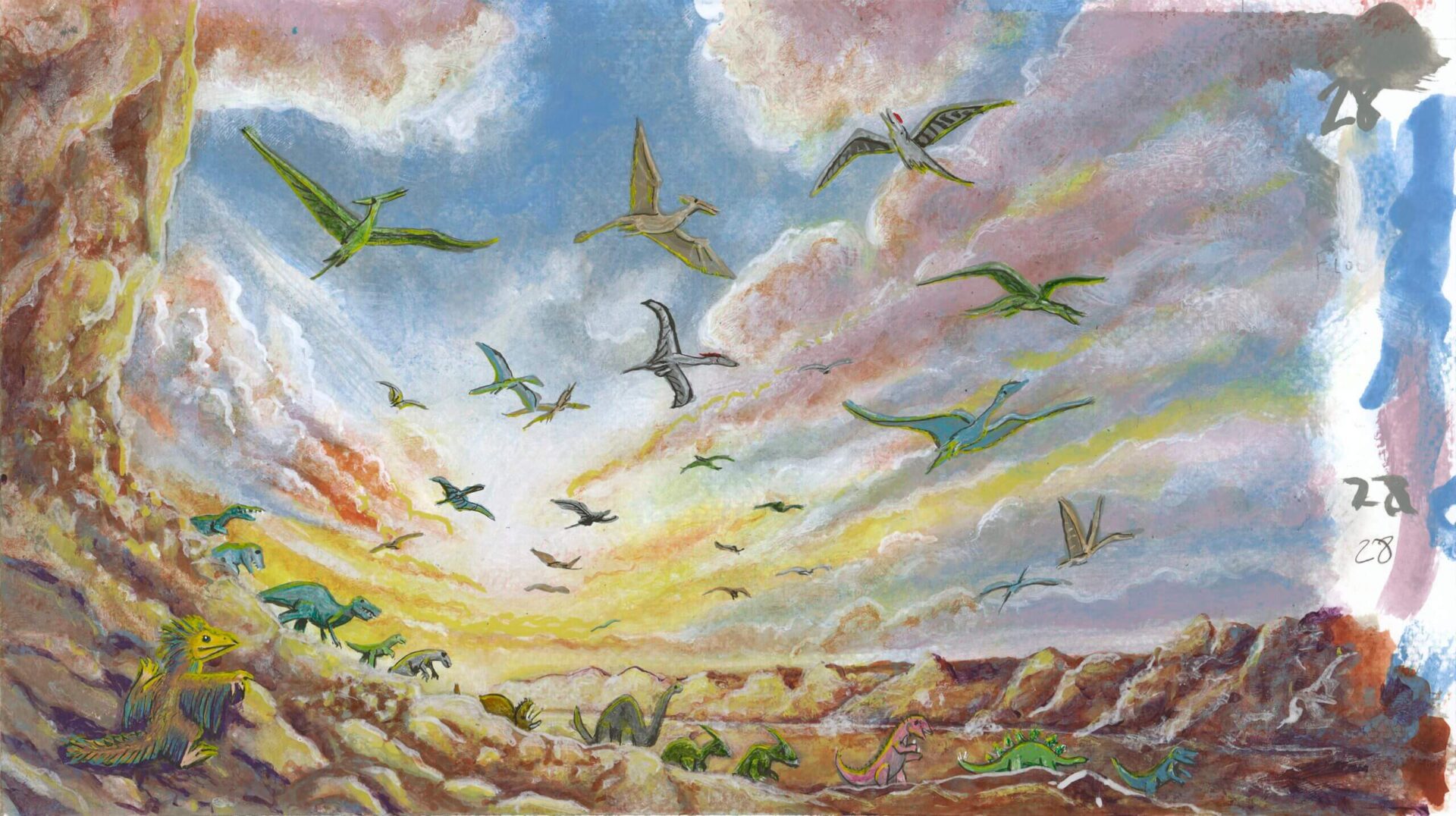
I sent Clark rough sketches and written descriptions. When words failed—when I could not fully explain that I wanted a whale superimposed over an Argentinosaurus beside a Dinobird scampering up a tree in a primordial forest—I drew it an Clark turned the pictures into beautiful art, such as the image that now adorns this website homepage..
I continued creating sketches, writing descriptions, and sending photographs of modern birds. Clark continued to translate these into illustrations.
We exchanged messages, building page layouts based on the aspect ratio of the book. I used as my template a favorite book from my collection, The Glorious Flight. I liked how it sat across my lap—not too tall, just wide enough.
We worked back and forth until we captured the feeling of the poem in the images.
I drove to Florida to pick up the original artwork.
From there, the illustrations had to be translated into digital format and prepared for print. The expert I hired for this stage connected me with an editor. She formatted the text, adjusted the layout, and prepared the files so they could be rendered into print format.
Kathesaurus Books, etc., LLC Is Hatched
As the book came together, I realized I wanted to publish other works that were already on my sketch board.
Incorporating gave me the clearest path forward—for growth, ownership, and market access.
I also realized that a company could eventually provide a home for other like-minded writers under the umbrella of Kathesaurus.
I purchased the domains, licensed the company, set up a rudimentary website, and began publishing through Amazon while learning the IngramSpark system and its potential for broader distribution.
The artwork had to be reformatted to 8.5 × 11 for KDP, even as I prepared files for IngramSpark.
When I held the Amazon edition in my hands, I knew the first page needed revision. It was too wordy for children.
I reworked it for the IngramSpark edition, and those changes will be reflected in the Amazon version shortly.
For God So Loved the Dinosaurs is gaining traction:
- Jigsaw puzzles completed
- Coloring books and plushies in development
- Board game (Escape from Asteroid) in early stages
As these pieces have taken shape, I have returned to completing additional books:
- Survive and Thrive After Open Heart Surgery
- Miss Mighty Mito
Both of which are due out in June.